Our supportive approach to training
Our approach to personal safety training is shaped by extensive experience delivering sessions across statutory, voluntary, and community-based organisations. We recognise that personal safety risks are complex and highly contextual. As a result, our training goes beyond compliance or theory: it is practical, trauma-informed, engaging, and designed to lead to real-world behavioural change.
Preparation is central to our philosophy. Effective personal safety training starts well before the session itself and continues after it ends, ensuring learning is embedded into practice and organisational systems.
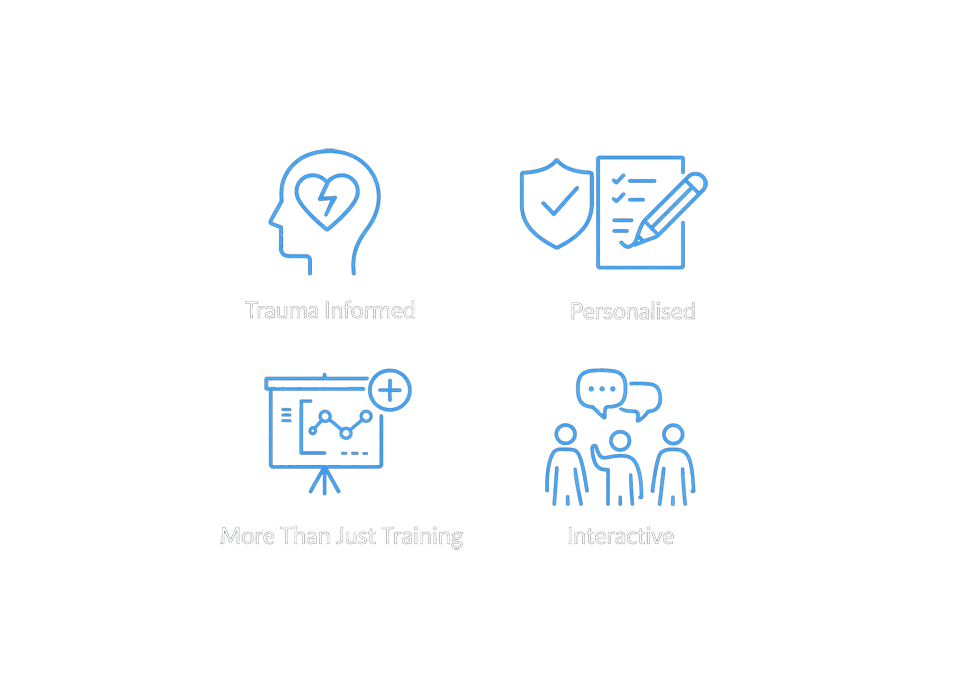
1. Trauma-Informed
We deliver all personal safety training through a trauma-informed lens. Many staff support individuals who have experienced trauma, and many workers themselves carry the impact of challenging or high-risk incidents. Our training recognises this reality and prioritises psychological safety alongside physical safety.
We focus on:
- Understanding how trauma can influence behaviour, communication, and escalation.
- Helping staff recognise stress responses in themselves and others.
- Reinforcing approaches that emphasise dignity, choice, boundaries, and de-escalation.
- Avoiding fear-based messaging and instead building confidence, awareness, and control.
2. In-Person, Interactive Training
Based on our delivery experience, we strongly believe that personal safety training is most effective when delivered in person. Face-to-face sessions allow for interaction, observation, discussion, and practical demonstration that cannot be replicated through e-learning or online learning alone.
A key added benefit of in-person delivery is the provision of protected time away from day-to-day work pressures, giving staff the space to reflect, reset, and fully engage with the learning. This dedicated time enables teams to openly discuss concerns, share ideas, and explore consistent approaches to managing risk, strengthening collective understanding and peer support.
Our sessions are highly interactive and include:
- Scenario-based group exercises grounded in real personal safety situations
- Demonstrations of escalation, disengagement, and self-protection principles where appropriate
- Opportunities to practise responses in a controlled, supportive environment
- Facilitated discussion that draws on participants’ lived experience and team perspectives
Particular attention is given to recognising escalation early, responding proportionately, and knowing when and how to safely withdraw. Sessions are designed to be engaging, inclusive, and confidence-building, using appropriate humour and shared learning to support participation, team cohesion, and long-term retention.
3. Bespoke Delivery Informed by Pre-Training Questionnaires and Live Feedback
No two personal safety contexts are the same. Our training is therefore spoke-based and tailored to the specific risks, roles, and environments of each organisation.
Preparation is key. Ahead of delivery, we issue a short questionnaire to gather insight on roles, risks, previous incidents, confidence levels, and existing controls. This information directly shapes the structure, scenarios, and emphasis of the session.
During training, we adapt content in real time based on discussion and feedback, ensuring relevance and responsiveness throughout.
4. Training Plus: Follow-Up Reporting, Feedback, and Resources
We do not view personal safety training as a one-off event. In our experience of delivering personal safety training, there are always points identified during sessions that benefit from follow-up, whether this relates to procedures, confidence, supervision, or organisational systems.
To address this, we build in structured action planning at the end of each session to reinforce learning and support participants to translate knowledge into practice when they return to their day jobs. This enables individuals and teams to identify realistic next steps within their role and working environment.
Following delivery, we can provide:
- A concise feedback report summarising key themes, risks identified, and learning points.
- Practical, proportionate recommendations linked to policies, procedures, and risk assessments.
- Facilitated action planning outputs that capture individual and team commitments, supporting accountability and follow-through.
- Advice and guidance on strengthening personal safety arrangements, escalation pathways, and staff support mechanisms.
- Shared resources to support ongoing learning, including guidance materials, checklists, tools, and signposting to best practice.
This approach ensures learning does not end at the session itself, but leads to improved confidence, safer decision-making, and measurable improvements in day-to-day practice.
Training Options
- One day and half day courses (In-person or online delivery)
- Induction course for new starters
- A refresher course for more experienced staff members
- Lone working workshop – focused less on training and more on reviewing current practice for the purpose of developing and implementing new safer ways of working
- Other bespoke options to suit your needs
Full day course outline – example
- Lone working risk assessment framework
- Dynamic risk assessment tool
- Safeguards and client focused risk assessments
- Lone working tools
- Considerations for: working people’s homes, walking to properties, driving
- Property risk interactive exercise: dogs, drugs, weapons, needles, cuckooing
- Communication and the adaptive unconscious
- Trauma, Jenga anger model and de-escalation
- Action planning
For a full course outline please email us.

Case studies
We draw on a bank of case studies that can be used interchangeably to bring key personal safety principles to life and provide meaningful, real-world context. Informed by our delivery experience, these case studies cover scenarios such as the potential dangers of supporting people in the community, the importance of lone worker tracking systems, visiting clients outside standard office hours, and managing inappropriate behaviour while maintaining clear professional boundaries.
Interactive elements
Engagement and interaction are central to the effectiveness of our training sessions. We use a mix of games, scenarios, and practical activities to encourage participation, reinforce learning, and build confidence in a supportive environment. Training is designed to accommodate different learning styles, combining demonstrations, group work, and individual reflection so that participants can engage in ways that best support their learning and real-world application.
 Safer Support - Personal Safety & Cuckooing Training